




By Ryan Fair
I’ve walked past a lot of good deer spots in my life. At the time, I didn’t know they were good spots. They were just little ditches, beat-down fence crossings, narrow strips of brush or places where the timber pinched down for 30 yards before opening back up. Nothing about them looked impressive enough to stop and hang a stand.
Then you hunt long enough and start paying attention to where mature bucks actually show up, and you realize those little places matter. A lot. I call them micro funnels. They’re not the big, obvious funnels everybody circles on an aerial map. Most of them are small enough that you can stand in the middle of one and never realize what you’re looking at unless the deer sign gives it away.
But put the right little pinch between bedding and food and it can turn an ordinary piece of timber into a spot where bucks naturally pass within bow range.

Inside corners are classic places for deer movement to tighten up, especially when cover carries all the way from bedding toward the food source.
Stop Looking for the Giant Funnel
When I was younger, I thought a funnel had to be obvious. I was looking for a big neck of timber between two fields, a saddle between ridges or some major creek crossing with deer trails worn down to dirt. Those are all good places, and I’ll hunt them every chance I get. The mistake was thinking those were the only funnels that mattered.
Deer take the easy route more often than we probably give them credit for. If there’s a steep ditch bank, they’ll usually find the easy crossing. If a fence has one low spot, deer seem to find it. If a big blowdown blocks part of a trail, they’ll slide around one end of it and keep using that same path. None of that sounds like much, but if that little obstacle puts a buck through a 20-yard opening instead of letting him wander anywhere through a hundred yards of timber, I’m interested.
That’s the whole game with these places. You’re looking for anything that takes deer movement and tightens it up.
The Good Stuff Is Usually Between Two Obvious Places

A trail camera can help confirm whether a subtle funnel is being used by mature bucks and, more importantly, when they are moving through it.
Most hunters can identify bedding. We can usually figure out where deer are feeding, too. The part that gets overlooked is everything in between. Say you’ve got a nasty creek-bottom bedding area behind a bean field. There may be 300 yards of timber between the two. Somewhere in there might be a shallow ditch, an old fence row and a patch of thick honeysuckle. A buck could technically walk anywhere through that woods, but he probably won’t.
Maybe the ditch gets steep except for one little crossing. Maybe the old fence has one spot where a tree knocked the wire down. Maybe that thick cover narrows down and gives him a place to stay hidden almost the entire way toward the field. That’s where I start looking harder.
I’m not always trying to sit right on top of the bedding area, and I don’t necessarily want to be hanging over the food source either. A lot of times the better play is finding that little spot halfway between the two where the buck has fewer options. Now you’ve got him moving naturally and you don’t have to force the situation.
Little Terrain Changes Matter

Blowdowns can change deer movement overnight. When an obstacle forces deer around one end, it can create a shot opportunity that did not exist before.
One thing deer hunting has taught me is that terrain doesn’t have to be dramatic to matter. A ditch might only be a few feet deep. A creek bank might only be steep for 50 yards. There might be one little rise in an otherwise flat woods. Deer notice all of it.
I’ve watched deer walk an extra 40 or 50 yards just to use an easier creek crossing. I’ve also watched them hit the same opening in a fence night after night when they could’ve jumped anywhere along it. The same thing happens with deadfalls and brush.
One big tree comes down across a trail and suddenly deer start slipping around the root ball or circling the other end. After a while, that new route gets worn in and becomes the trail. That’s the kind of stuff you can’t always see sitting at home looking at your phone. Sometimes you have to get in there and walk it.
Ask Why the Trail Is There
This is probably the biggest thing I’ve changed in my scouting over the years. I used to find a good deer trail and think, “Well, there’s a trail.” Now I want to know why it’s there. That sounds simple, but it changes how you look at the woods. If you find a trail running along a ditch, follow it far enough to see what the deer are doing. If it crosses a fence, see why they picked that exact spot. If several trails suddenly come together, stop and look around.
Something caused that. Maybe the cover gets tighter. Maybe the terrain forces deer around something. Maybe it’s the easiest route between two places they want to be. Once you figure out the reason, you can start finding similar places on the rest of the property. That’s when scouting gets fun, because you quit wandering around hoping to find sign and start predicting where the sign should be.
Mature Bucks Don’t Always Use the Main Trail

Mature bucks often stay just inside thicker cover instead of following the most obvious trail. Those secondary routes are worth paying attention to.
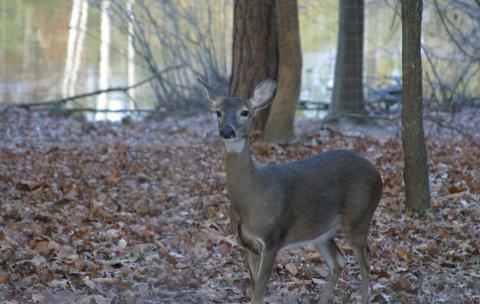
Another thing I’ve noticed is that mature bucks have a habit of being just a little bit off from everything else. You’ll find a main deer trail that looks like cattle have been using it, and it’s covered with doe and yearling tracks. Then 25 yards back in the thicker stuff there’s a faint little trail you could almost miss. That’s the one I want to look at.
Older bucks seem to like keeping a little cover around them, especially during daylight. They may travel parallel to the main trail without ever stepping onto it. The real sweet spot is where something eventually pinches that secondary route toward the main one.
Maybe the creek gets tight against a hillside. Maybe a thick patch narrows down. Maybe two ditches meet. Now that buck that has been hanging off by himself suddenly has to come through a much smaller area. That’s where a micro funnel earns its keep.
Don’t Ruin It Once You Find It
This is where I’ve made mistakes before. You find a smoking-hot little funnel and immediately want to hang right on top of it. Sometimes that works. Sometimes you educate every deer using it. I’d rather back off a little and hunt the funnel from the edge if I can. Give yourself enough room that deer can move naturally without walking directly under the tree. The wind has to work, too. A perfect pinch point with a bad wind is still a bad setup.
Access might be even more important. If deer are using a little strip of cover because it makes them feel safe, the last thing I want to do is march right through it every time I hunt. I’ll take a longer walk around if it keeps my scent and ground disturbance out of the funnel. A good spot stays good a lot longer when the deer don’t know you’re there.
The Spots That Don’t Look Like Much
Some of my favorite deer spots today are places I probably wouldn’t have given a second look years ago. They’re too small, too plain, and they don’t look good enough on a map. That’s kind of the point. Everybody notices the giant creek crossing. Everybody sees the big timber funnel between two crop fields. The little stuff gets missed.
So the next time you’re scouting, slow down. Look at the trails. Follow them. Figure out why the deer are walking where they are. You might find that a sagging fence, shallow ditch or 20-yard strip of brush is doing more to control deer movement than the big feature you came there to hunt in the first place.
Those little funnels aren’t flashy. They just put deer in front of you.
And in the end, that’s about all I need a hunting spot to do.